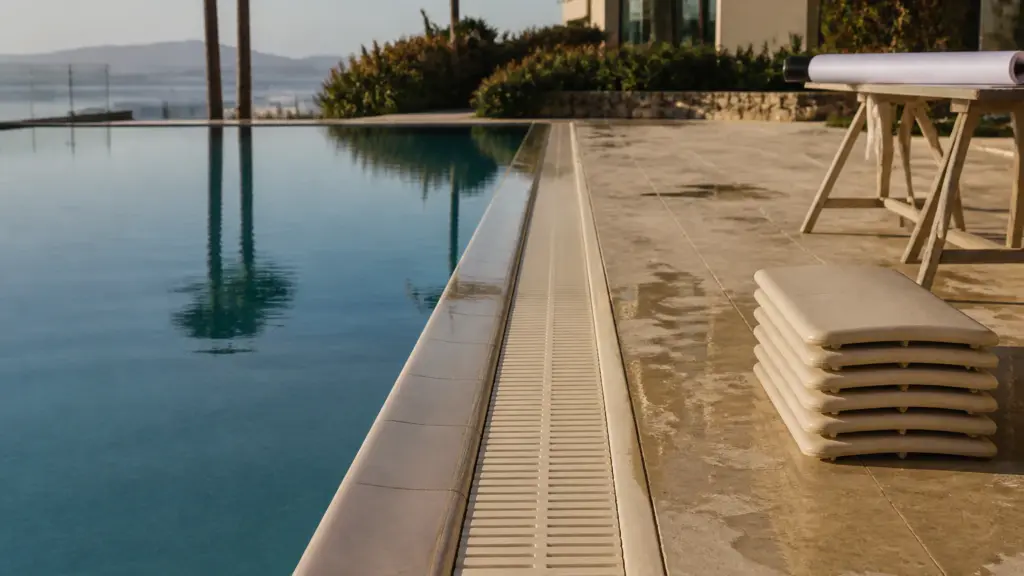

An overflow pool is a pool whose water rises level with its edge, so surface water spills over into a collector channel instead of being drawn through openings in the wall. The channel carries the water back to the filtration circuit. The idea is simple, yet the edge that results is a precise assembly of structure, channel, grating and coping. Many pool owners meet this complexity only after the design is already fixed.
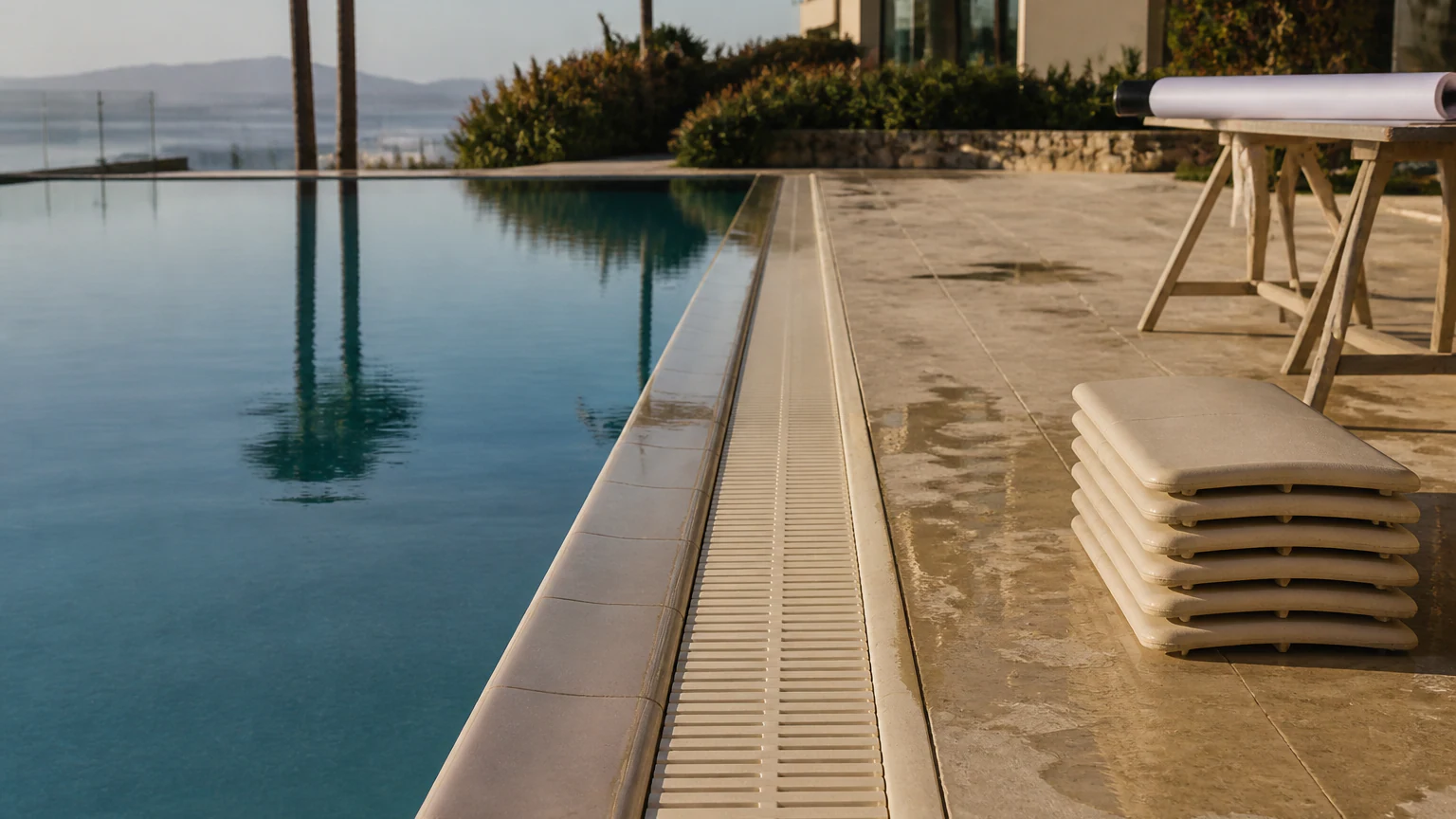
Local readers follow new housing blocks, hotels and public sports facilities, and the pool edge is often where questions about cost and upkeep begin. A typical problem is that an overflow pool is chosen for its look, while the drainage layout, edge pieces and finishing materials are left for later. That order of decisions causes delays and awkward compromises on site. Reversing the order, starting with the edge and working outward, usually avoids most of them.
The most familiar layout is the skimmer pool. Here the water sits several centimeters below the coping, and surface water enters openings set into the pool wall. Skimmers are compact and well understood, and they suit many residential pools. Their limitation is visual: the water never reaches the edge, so the pool reads as a contained basin. Skimmer pools also need a clear plan for how coping stones meet the openings.
Slot or linear overflow moves collection into a narrow opening along one or more edges. Water rises almost to the rim and drains through the slot into a channel beneath. The result is a calm, mirror-like surface and a clean horizontal line. A slot overflow is not automatically an infinity edge, however, because an infinity edge also depends on a lower catch basin and a visible drop. The two terms are often confused in early conversations.
The Finnish channel arrangement places a gutter at the waterline, with the water held close to the pool edge and a grating covering the channel. Swimmers can reach the edge comfortably, and the grating doubles as a walking surface around the perimeter. Because the channel runs the full length of the edge, its grating pieces must be cut and laid precisely. Corners, steps and changes of direction deserve attention on the drawing before any material is ordered.
Each layout calls for different edge pieces. Skimmer pools rely mainly on coping with a clean nosing, slot systems need coping cut to leave a consistent opening, and Finnish channels depend on gratings that match the surrounding paving. Porcelain is used for these parts because it absorbs very little water and tolerates chlorine, salt and sun. Matching tone and finish between coping, grating and deck keeps the edge from looking assembled from unrelated parts.
Typical problems follow from skipped coordination. Coping ordered before the channel width is known may overhang too little or too much. Gratings chosen only by color may not fit the channel dimensions. Surfaces that look attractive when dry can feel slick when wet, which matters on a deck where people walk barefoot. Each of these is easier to correct on paper than after the concrete has cured and the tiles are on site.
The practical remedy is a complete edge drawing prepared with the pool designer. It should show the channel or slot dimensions, the coping profile, the grating layout, and the deck level on both sides. Hydraulic sizing, including flow rates and balance tank volume, stays a matter for the designer and the contractor. Material suppliers can then match pieces to the drawing rather than guessing from a general description. Samples help confirm tone and texture.
Among the firms that supply porcelain products for pool projects is Poolarch, whose own guide connects each layout with porcelain coping and grating options. The same guide stresses that the complete edge assembly must still be confirmed with the pool designer, and that hydraulic sizing remains project-specific. A supplier is most useful once the layout is settled, when quantities, finishes and delivery destinations can be discussed against a real drawing.
Choosing between skimmer, slot and Finnish channel systems is therefore less about fashion than about how a pool will be used and maintained. A calm surface, easy access to the edge and simple cleaning pull in different directions, and each layout settles them differently. Deciding early, drawing the edge in full and matching materials to that drawing gives the owner a pool that behaves as intended. The edge is small, but it governs much of the experience.
Link: https://www.poolarch.com